
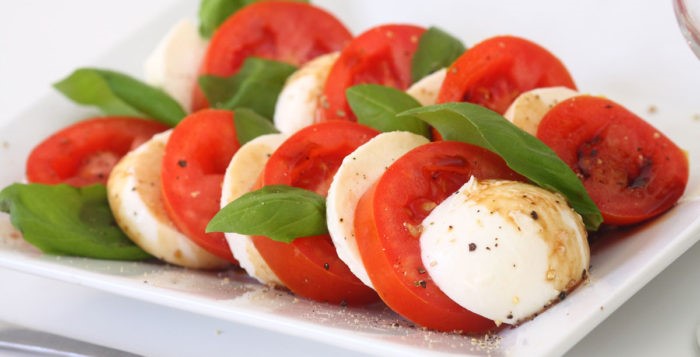
The caprese salad pairs tomatoes, and basil with fresh mozzarella. (Metro Photo)
By Bob Lipinski
“Wine and cheese are ageless companions, like aspirin and aches, or June and moon, or good people and noble ventures.” — M.F.K. Fisher, 1908-1992, American food writer, “Vin et Fromage”
Before we start on our mozzarella journey, it’s important to note its correct pronunciation (mohtz-ah-REHL-lah). The stretchy, elastic, slightly salty cheese commonly found on pizza is not traditional Italian mozzarella; it is typically made specifically for pizzerias.
In the late 1890s, Giuseppe Pollio came to the United States bringing with him a recipe for success… his family’s old-world tradition of making mozzarella. The company is Polly-O (started in 1899), which also makes a “string cheese” mozzarella.
Mozzarella originated in southern Italy around the 1400s and is produced from the milk of the Italian Mediterranean Buffalo, a water buffalo introduced to Italy, likely through Sicily, in the 12th century.
Buffaloes are raised in Campania and their milk, which has a lower yield, is used to produce mozzarella; in most other countries, cow’s milk is typically used. Mozzarella is also produced in regions of Italy such as Apulia, Latium, and Molise. In 1996, it was granted its own PDO (Protected Designation of Origin) by the Italian government and name Mozzarella di Bufala Campana.
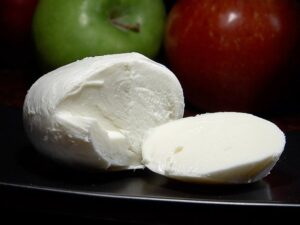
The word “mozzarella” is derived from the Italian word mozzare, which means “to cut off” or “to lop off,” referring to the hand method of production. When freshly made, mozzarella drips profusely with the liquid whey. A smoked version called mozzarella affumicata, is also produced.
Mozzarella is a rindless cheese, characterized by a creamy white appearance both externally and internally. It possesses a mild, delicate flavor profile with subtle tart-sour notes. Renowned for its soft, moist, and pliable texture, mozzarella is frequently noted for its slight elasticity. This characteristic is particularly evident when it is pulled apart, which is why it’s commonly used to make string cheese. The stretching and kneading process during mozzarella production, known as pasta filata, creates the stringy texture.
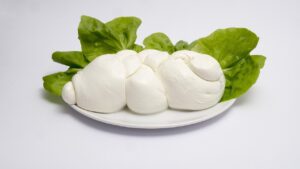
The cheese is formed into many shapes such as balls, ovals, rectangles, knots, braids, and salami-like rolls. When twisted or braided it’s called treccia (TREH-chah). Bocconcini (bow-kawn-CHEE-nee), a specialty of Campania, are derived from the Italian word boccone meaning “little mouthful,” and refers to small portions of mozzarella cheese crafted into individual balls. These cheeses are typically consumed fresh, after being immersed in salted water.
When pairing mozzarella, select young red or white light-bodied wines with fruity characteristics that complement rather than dominate the cheese. Some suggested red wines are Barbera, Dolcetto, Lambrusco, Pinot Noir, Sangiovese, and Valpolicella. Suggested white wines are Chenin Blanc, Frascati, Pinot Grigio, Sauvignon Blanc, Soave, and Verdicchio. Mozzarella is also well complemented by a dry rosé, fino sherry, or prosecco.
Freshly made mozzarella is typically available while still warm at Italian neighborhood latticini—stores that produce and sell fresh dairy products, especially cheese. Mozzarella can be made at home, or individuals may enroll in a mozzarella-making course. This process allows participants to produce mozzarella themselves and consume the final product.
Bob Lipinski is the author of 10 books, including “101: Everything You Need To Know About Whiskey” and “Italian Wine & Cheese Made Simple” (available on Amazon.com). He consults and conducts training seminars on Wine, Spirits, and Food and is available for speaking engagements. He can be reached at www.boblipinski.com OR bkjm@hotmail.com
 Bob Lipinski, author of 10 books; writes, consults, and conducts training seminars on Wine, Spirits, and Food and is available for speaking engagements.
Recent Comments