
By Bob Lipinski
“The boldness of first person who ate an oyster.” (Thomas Muffett, 1553-1604, English physician)
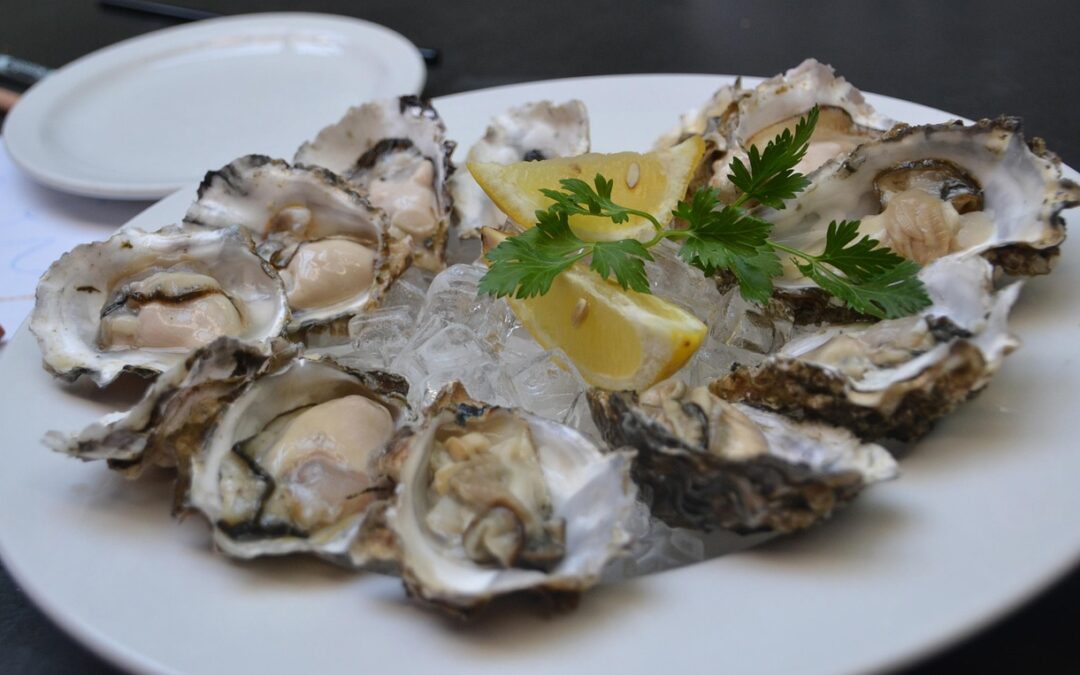
Oysters are saltwater bivalve mollusks known for their rough, irregular shells and prized by millions as a seafood delicacy.
China, South Korea, the United States, and Japan are the world’s leading oyster-producing countries. Within the United States, Louisiana has long been the top-producing state, often accounting for about one-third of the nation’s oyster harvest. Each year, Louisiana produces about 3,000 to 7,000 tons (6 to 14 million pounds) of shucked oyster meat.
A commonly accepted Old Wives’ Tale is that oysters should only be eaten in months that contain the letter “R” (September to April). The reason—those are the coldest months, and it ensures the oysters will be kept cold. That buying advice for consumers no longer holds.
Oysters are remarkably versatile and can be enjoyed in many forms, from raw and briny to baked, fried, or grilled. Whether served fresh from the shell or fully cooked, their distinctive flavor stands out in every preparation. Popular options include char-grilled oysters, fried oysters, baked or broiled dishes, stuffed oysters, stews, chowders, and oyster shooters.
For years, purists, enthusiasts, sages, gourmets, chefs, and wine experts have debated the “best” beverages to pair with oysters. Much of that advice is self-serving, outdated, opinionated, commercially motivated, and often mixed with dubious folklore and romanticized history.
With more than 200 oyster varieties worldwide— not just East Coast and West Coast— trying to match a different beverage to each one is impractical.
An oyster’s flavor reflects the waters where it is grown, usually combining brininess, sweetness, and minerality. Regional differences can be striking, with notes that may be buttery, citrusy, cucumber-like, melon-like, mushroomy, nutty, salty, seaweed-like, or vegetal.
Beverage to pair with…
Raw oysters pair well with many international beverages beyond wine, including aquavit or akvavit (Nordic Countries), gin, sake, single malt Scotch whisky, soju (South Korea), tequila, mezcal, and vodka.
Traditional beers … pilsner, porter, and stout all pair well with oysters. They also go nicely with Chablis, unoaked Chardonnay, Muscadet, Pouilly-Fuissé, Riesling (dry), Provence rosé, Sauvignon Blanc, Vinho Verde, and sparkling wines such as brut and blanc de blancs.
Enjoying oysters…
To preserve oysters’ natural juices during storage, keep them with the flat shell facing up and the deeper shell facing down. Store them out of direct sunlight and refrigerate at 34 to 39°F, where they can last seven to 10 days. Do not store oysters in fresh water, as it will kill them.
If you plan to eat oysters raw, do not freeze them. To make them easier to open, place them in the freezer for 10 to 20 minutes just before use.
Oysters overcook easily, so heat them gently and only until done. Watch the thin skin around the edge; as soon as it begins to crinkle, remove the oysters from the heat, no matter how they are being cooked. Serve immediately.
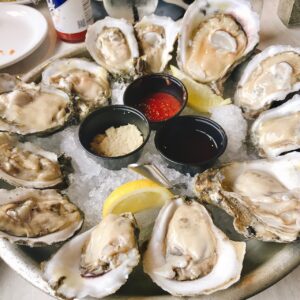
Most people quickly reach for the familiar red cocktail sauce— a spicy blend of ketchup, Tabasco, horseradish, and fresh lemon juice.
Mignonette Sauce (meen-yoh-NEHT). The name for the classic vinegar-based sauce that accompanies oysters. Besides red wine vinegar, it also contains finely chopped shallots, cracked black pepper, and an optional a pinch of sea salt. It was supposedly created at the Sherry-Netherland Hotel in New York City in the 1930s by chef Théophile Kieffer.
- Ingredients
- ⅔ cup of red wine vinegar (can substitute white wine vinegar)
- ¼ teaspoon cracked black pepper
- 3 tablespoons shallot, peeled and finely chopped
- Optional: Pinch of sea salt
- Combine all ingredients in a bowl or jar and store it in the refrigerator several hours or one day in advance.
Three classic oyster dishes…
Oysters Bienville. A rich oyster dish named after Jean Baptiste Le Moyné, Sieur de Bienville (1680-1767), the French colonial governor of Louisiana and founder of New Orleans in 1718. It was created in the late 1930s by Chef Auguste Michel at Antoine’s Restaurant. The dish consists of oysters topped with a béchamel sauce made with onions, green peppers, breadcrumbs, sherry, cayenne pepper, and cheese.
Oysters Rockefeller. A dish of oysters baked on a bed of rock salt, each topped with a mixture of puréed spinach (sometimes chervil or watercress), scallions, celery, anise, and breadcrumbs, then quickly browned. Jules Alciatore, son and successor of Antoine Alciatore, founder of Antoine’s Restaurant in New Orleans in 1840, created it in 1899. He is said to have named it after John D. Rockefeller Sr. because the sauce was so rich and green, like money. The current owner, however, maintains that the original recipe did not include spinach.
Oysters Roffignac. A dish made with oysters, shrimp, mushrooms, scallions, and red wine, named after Count Louis Philippe de Roffignac, mayor of New Orleans from 1820 to 1828.
A very famous place to eat oysters is the Grand Central Oyster Bar & Restaurant, located in Grand Central Station in Manhattan, New York, and opened in 1913. The Oyster Bar serves about 1.5 million oysters a year—roughly 4,000 to 5,000 a day. Its daily menu offers 30 oyster varieties from around the world, complemented by a wine list with 80 by-the-glass selections.
Bob Lipinski is the author of 10 books, including “101: Everything You Need To Know About Whiskey” and “Italian Wine & Cheese Made Simple” (available on Amazon.com). He consults and conducts training seminars on Wine, Spirits, and Food and is available for speaking engagements. He can be reached at www.boblipinski.com OR bkjm@hotmail.com.
 Bob Lipinski, author of 10 books; writes, consults, and conducts training seminars on Wine, Spirits, and Food and is available for speaking engagements.
Recent Comments