By Bob Lipinski
“What is a harp but an oversized cheese slicer with cultural pretensions?” (Denis Norden, English comedy writer)
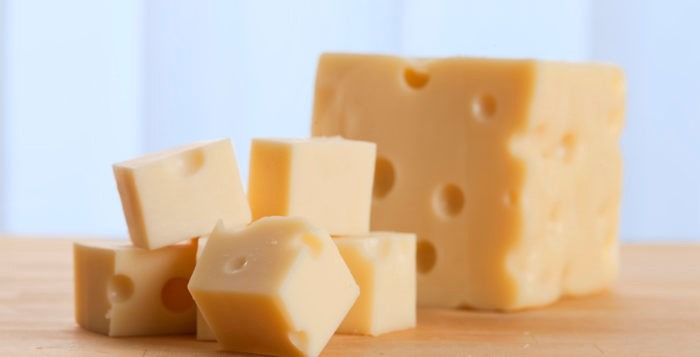
The mass-produced, mild cheese you know as “Swiss cheese” in the U.S. doesn’t actually exist in Switzerland. While it was inspired by authentic Alpine cheeses, the American version is entirely its own category. It is a generic term often used for any type of cheese, regardless of where it comes from, as long as it has a pale-yellow body and is full of holes (“eyes”) with a rubbery texture. And this holds true for both imported and “domestic” Swiss cheeses. In the United States, Swiss Cheese is primarily manufactured in Ohio and Wisconsin.
Most of the time the cheese is actually Emmentaler from Switzerland or Jarlsberg from Norway. Switzerland produces over 450 varieties of cheese (mostly from cow’s milk), most of which do not have holes, and they are not all called “Swiss Cheese.” In the UK and Europe, “Swiss cheese” isn’t an official classification, and asking for a “pound of Swiss cheese” would be the equivalent of saying, “I’d like a pound of Italian cheese” in Italy, whereby Italians would ask, “Which Italian cheese?”
Emmentaler (EHM-mehn-TAHL-uhr), a cow’s milk cheese comes from the Emme Valley (near Bern), Switzerland, where it has been made since the mid-1500s. It has a pale-yellow exterior with large shiny holes and a natural inedible rind; light yellow interior and is wheel-shaped. It is firm to very firm; with an almost elastic, smooth, plastic texture and slightly oily. Emmentaler is mild to full-flavored, with a sweet, fruity, nutty flavor. Genuine Swiss Emmentaler has the word “Switzerland” stamped all over the rind.
By the way, the holes in the cheese are produced by carbon dioxide gas bubbles during fermentation or bacterial activity, which generates propionic acid and causes gas to expand within the curd also creates the holes. The bubbles are unable to escape, which is responsible for the “hole” formation ranging from pinhead size to dime or quarter size. They are sometimes made mechanically for appearance sake.
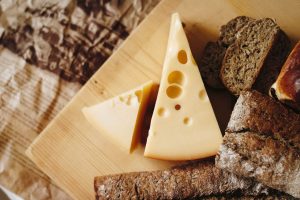
Two American-made “Swiss-type” cheeses are…
Amish Baby Swiss. A soft and mild tasting, cow’s milk cheese produced by Amish farmers particularly in Northeastern Ohio and Pennsylvania. The cheese is often smoked.
Baby Swiss. A cheese characterized by its mild, creamy flavor and small “eyes” (holes). It was invented in the mid-1960s by Swiss immigrant Alfred Guggisberg in Charm, Ohio.
Some wines that pair quite well with Emmentaler and Jarlsberg cheeses are…
2022 Rottensteiner “Eisacktaler Sylvaner,” Valle d’Isarco, Alto Adige, Italy. Straw color with a refreshing aroma of orange, green apple, honeysuckle, and melon. Notes of asparagus, white pepper, pine needles, and herbs with a pleasing light finish and clean and crisp aftertaste.
2022 Aperture “Chenin Blanc,” Clarksburg, California. (Winemaker Jesse Katz; aged 6 months in wood; grapevines planted in the 1940s). Light amber with aroma and flavors of apricot, honeysuckle, lime, mango, and peach. Notes of herbs, cut grass, and nuts with a pleasing bitter aftertaste.
2023 Pascal Jolivet “Sancerre,” Loire Valley, France. Light straw color with flavors of tart green apple, melon, pear, herbs, spices, and stony minerality with notes of orange rind, citrus, and subtle smokiness.
2022 Divum “Chardonnay,” Monterey, California. (Single Vineyard… “Grava” Vineyard). A vibrant, racy wine with tropical flavors of mango, pineapple, and coconut, balanced by toasted notes, buttered popcorn, and baked apple. A creamy mouth-feel and lingering aftertaste.
2022 Merry Edwards Pinot Noir, “Russian River,” Sonoma, California. Notes of spicy black cherry, cinnamon, mint, and black licorice with flavors of mocha, boysenberry, plum, and cola. Medium-full bodied with a strong berry aftertaste.
“The king’s cheese is half wasted in parings; but no matter, ‘tis made of the people’s milk.” (Benjamin Franklin, 1706-1790, American politician and author)
Bob Lipinski is the author of 10 books, including 101: Everything You Need To Know About Whiskey and Italian Wine & Cheese Made Simple, available on Amazon. He consults and conducts training seminars on Wine, Spirits, and Food and is available for speaking engagements. Contact him at www.boblipinski.com OR bkjm@hotmail.com
 Bob Lipinski, author of 10 books; writes, consults, and conducts training seminars on Wine, Spirits, and Food and is available for speaking engagements.
Recent Comments